A visit to Bifor, the Free Air Carbon Dioxide Enrichments Project
We last made a STT visit to Bifor in July 2018. The project was fairly new and not much could be said then about its success or otherwise. Now, after nearly ten years of operation, much has been learned and we were able to hear about the changes since those early beginnings.
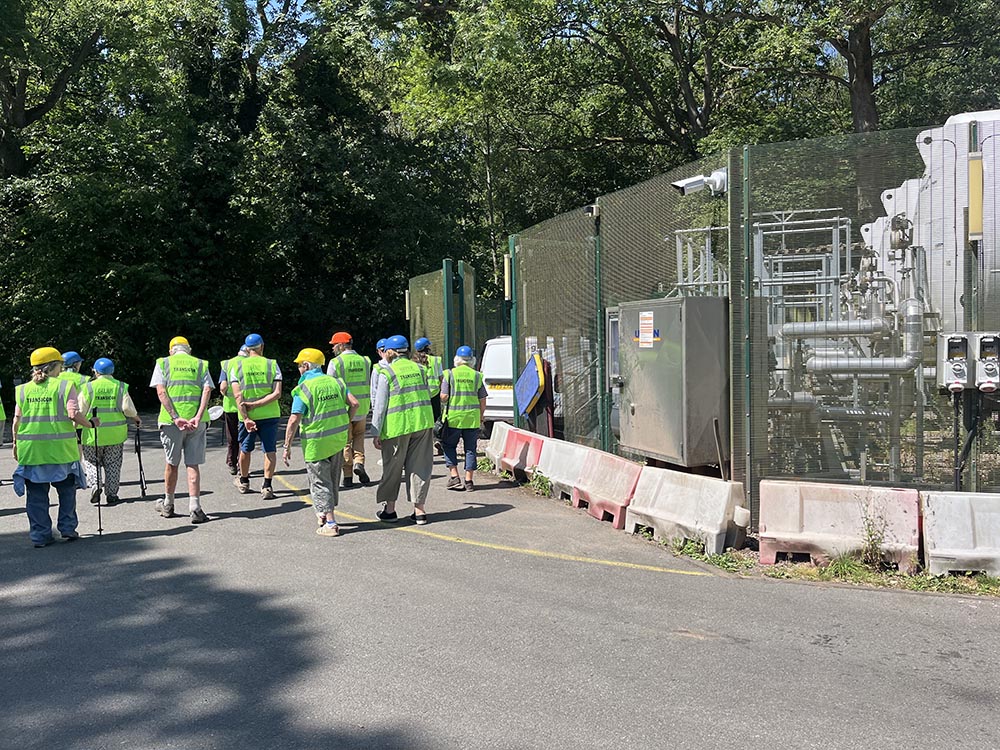
This visit was a little different from our normal ones in that we had to go on a Wednesday morning otherwise there would have been no-one to show us around and explain things to us. So, fortunately, this fascinating visit drew in 15 members, all eager to learn what had been happening here in the last 8 years and our guide was the very knowledgeable Dr. Kris Hart.
So what is Bifor about ? The letters stand for the Birmingham University Institute of Forestry and the project is known as the FACE Project or the Free Air Carbon Dioxide Enrichment Project. I don’t think I need to remind members about how photosynthesis operates in plants but for those who may have forgotten, very briefly trees take in Carbon Dioxide and Water and convert these to the sugary foods they need (the carbohydrates) and Oxygen which we need. Carbon Dioxide or CO2 is a greenhouse gas and the fact that trees and other plants can take it from the atmosphere is a great plus when trying to ameliorate global warming. So this project is looking at how trees can take in greater quantities of CO2 when there is likely to be more global warming in the future. As Kris told us as we entered one of the tree ‘arrays’, “we are now among trees of the future, we have created a future forest”.
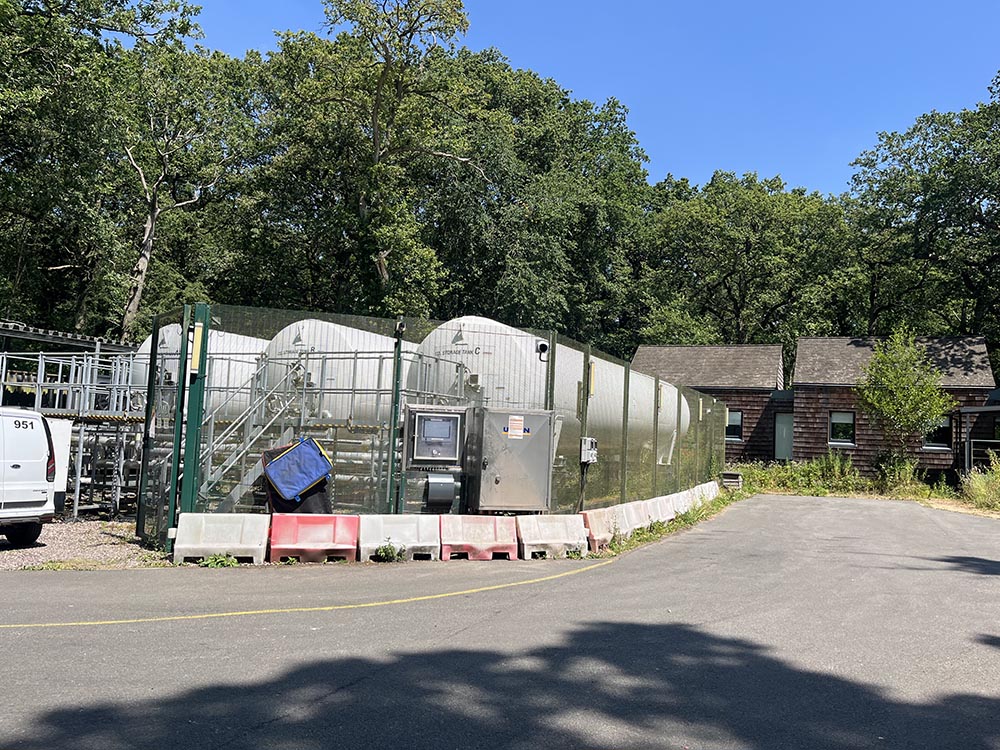
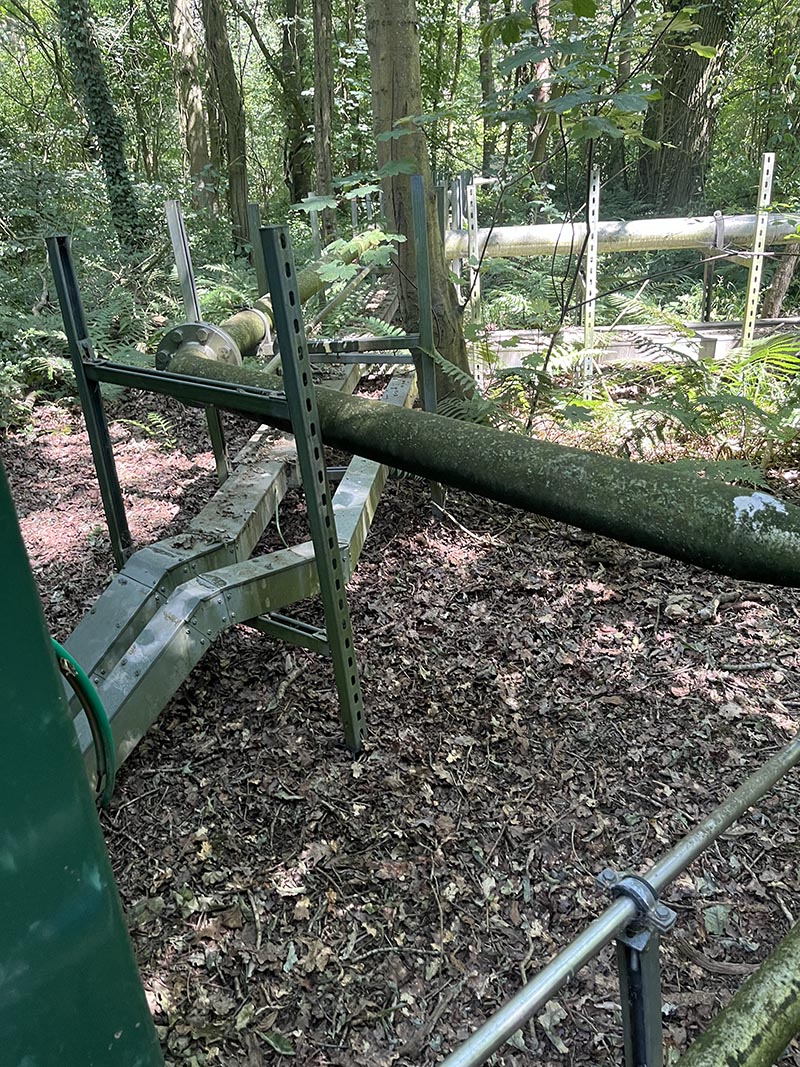
Everything is monitored: temperature, rainfall, wind, soil, the amount of sap flowing in the trees. If there is a high wind and the CO2 cannot be concentrated on the trees, it immediately switches itself off. The trees in each array are all broadleaved deciduous and all old-growth woodland. Most of the trees are Oak and Hazel and they receive enhanced CO2 from rings of towers around each array emitting this gas from 32 different points. Each array has a central “control” tower which acts like a tree to draw in CO2 as a tree would to measure the effects on the surrounding trees.
The costs of running this are immense. The whole project cost £15 million to instal and £2.5 million per year to run and is now funded up to at least 2031. But Kris insisted that we know that this money was not University money nor tax-payers’ money. It had all been derived from philanthropic donors
Now at this point I have to say that out in the forest I was not easily able to hear what Kris was telling us – it’s my hearing aids, don’t you know !!!! Or the birds were singing so loudly !!! So I am extremely grateful to Angela Hughes who, with the help of her sister, found for me an excellent New Scientist article about this whole project. So I shall now quote from that.
“At present the world’s forests absorb 7.6 million tonnes of CO2 each year. Temperate forests, such as these in the UK, are responsible for almost half of that uptake. As pollution (including CO2) increases, can we rely on trees continuing to be an efficient carbon sink, especially as by 2050 the atmospheric concentration of CO2 will be 40% higher than it is today ? Bifor has been looking carefully to see how trees respond to these increases in CO2. What should happen is that photosynthesis should increase so the trees taking in the additional CO2 will product more sugars for themselves and more oxygen for us.”
“Thankfully, the results at Bifor so far are promising.”
During the number of years of Bifor operating, putting the trees in the arrays under elevated CO2 conditions, “the mature oaks have increased their photosynthetic rate and are producing about 11% more wood each year compared with nearby trees under today’s conditions.”
A similar experiment has been conducted among the Eucalyptus trees of Australia. This also began in 2017 but no link has been found between elevated atmospheric CO2 and extra tree growth. Why ?
Back to the New Scientist article: “The answer lies in the availability of nitrogen and phosphorus, key nutrients that enable trees to make use of excess CO2. In Australia, the forest was limited by a lack of nutrients, but the Staffordshire site has plenty – thanks in part to fertiliser use on nearby farmland.” Dr. Rob MacKenzie of Birmingham University says that “everything about the results we have got so far is really down to the fact that the forest has sufficient nitrogen to utilise the carbon.”
“There is also emerging evidence that the mature oaks are deploying new strategies to secure their supplies of nitrogen. They are growing new root networks at a rapid pace to mine for fresh nitrogen reserves in the soil.” The team at Bifor has found that, because of this, the trees are conserving their supplies of nitrogen by releasing less of it through their roots and leaves into the soil.
This still represents a “remarkable shift in activity for middle-aged trees” says MacKenzie.
“Other shifts are afoot in the forest. The trees in elevated CO2 conditions have more bitter chemicals in their leaves, which the research team suspects might be a sign they are investing more in their resistance to pests and diseases. There are also signs these trees might be recovering more quickly from short periods of heat stress, resuming photosynthesis activity before the control trees.”
But this might not be long-lasting when the nitrogen is used up. As the article tells us: “The trees under elevated CO2 are drawing down this excess (nitrogen) now…..and in previous experiments performed on younger trees, nitrogen supplies have eventually dwindled leading to a slump in the rate of photosynthesis.”
Although these trials can simulate future CO2 levels in the atmosphere, they can’t simulate future weather. “Advancing climate change will bring more frequent and more intense heatwaves, droughts and floods.” These trials at Bifor can tell researchers of the trees’ responses to these extreme weather events as they occur now “but it won’t be an accurate reflection of the wilder, more extreme conditions the forests will face by 2050.”
Finally, the article tells us that wood is only a temporary carbon store and when the trees eventually die, the wood rots and the stored carbon is released back into the atmosphere.
“ ‘It would be foolish, therefore, to rely too heavily on forests as a climate saviour,’ says MacKenzie, ‘even if their increased photosynthesis rate is sustained, it only helps, it’s not a solution.’ “
A really fascinating article and a really fascinating morning of discovery. Between the two pieces of information, we learn a lot about what Bifor is trying to do and how much is being achieved. I knew nothing about the role played by nitrogen. It’s almost unbelievable that this gas plays such an important role in carbon capture by trees.
Our morning didn’t end there but I’ll thank Doctor Kris here as he passed us on to his colleague to take us to the next part of the morning’s activities, a report for which will follow thanks to Peter, our Chairman
Norbury Estate
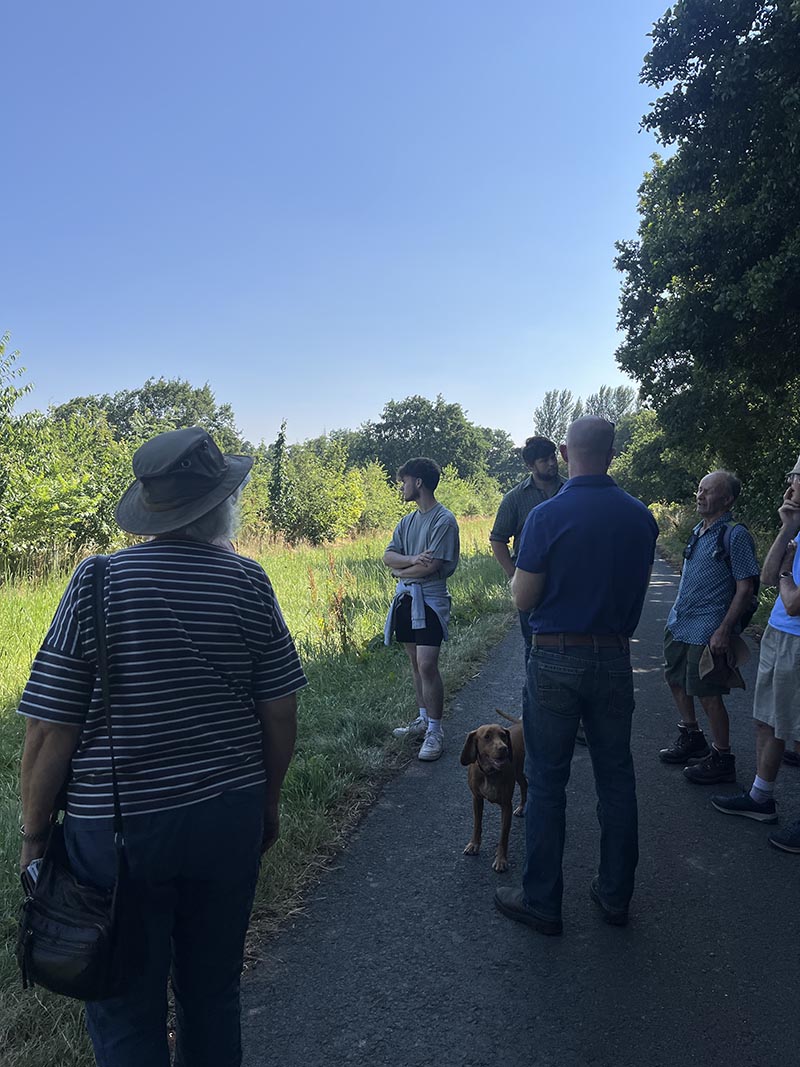
After visiting the BIFoR FACE experiment we were taken by Alex Malkin, Head Forester of Norbury Park, to visit the new plantations on the estate. We drove to the Norbury Estate sawmill and timber stores and from there walked a short distance to a typical example of the mixed-species plantations that are been developed over hundreds of acres of what had been arable farmland. Many tree species are grown together in an ‘intimate mix’, which results in faster growth rates than monocultures, as the trees compete less with each other, and problems due to pests and diseases are reduced. Deer are rarely seen on the estate and there is a rigorous grey squirrel control programme, using modified Kania traps developed on the estate. However, hares have been a nuisance, sometimes going along a row of trees and biting off the leader of each.
In this plantation we saw a larch that seemed amazingly large for its age and many other individual trees had grown noticeably strongly. Because of the rapid growth, a first thinning is required after only ten to fifteen years. Every fourth or fifth row of trees is removed to gain access. “Winners” are then selected, which are the individual trees that have grown most strongly, with good form. Side branches on these are pruned off, to one third of the tree’s height. Conventionally, the non-winners would be removed completely, but the Norbury approach is to pollard them. As a result, they continue to provide light competition which tends to prevent formation of more side-branches on the trunks of the winners. This process of ‘halo pollarding’ will be repeated every five to ten years until there is a crop of harvestable softwood or hardwood timber after only thirty or forty years.
We then walked to another new plantation which is an experiment in the inclusion of nitrogen-fixers into the species mix. With rising carbon dioxide levels, shortage of nitrogen in the soil is likely to limit tree growth in the future, rather than carbon dioxide. Robinia, Laburnum and Alnus are among the species being trialled in the experiment. All of them have a mutualistic relationship with soil bacteria that convert atmospheric nitrogen into ammonium, some of which becomes available to the tree, increasing its growth rate. This fixed nitrogen subsequently becomes available to the other trees, so the whole plantation should grow faster. The experiment will help to decide what proportion of nitrogen-fixers to include in species mixes and whether one species is particularly effective.
As you can tell, we learned a lot in the hour or so spent with Alex, who was an excellent guide. The Norbury Plantations are innovative, impressive and influential. They offer hope at a time when it is easy to take a very bleak view of the harm humans are doing to trees and forests on Earth.
Bifor Towers and pipe work for dispensing and monitoring CO2 into old forest woodland